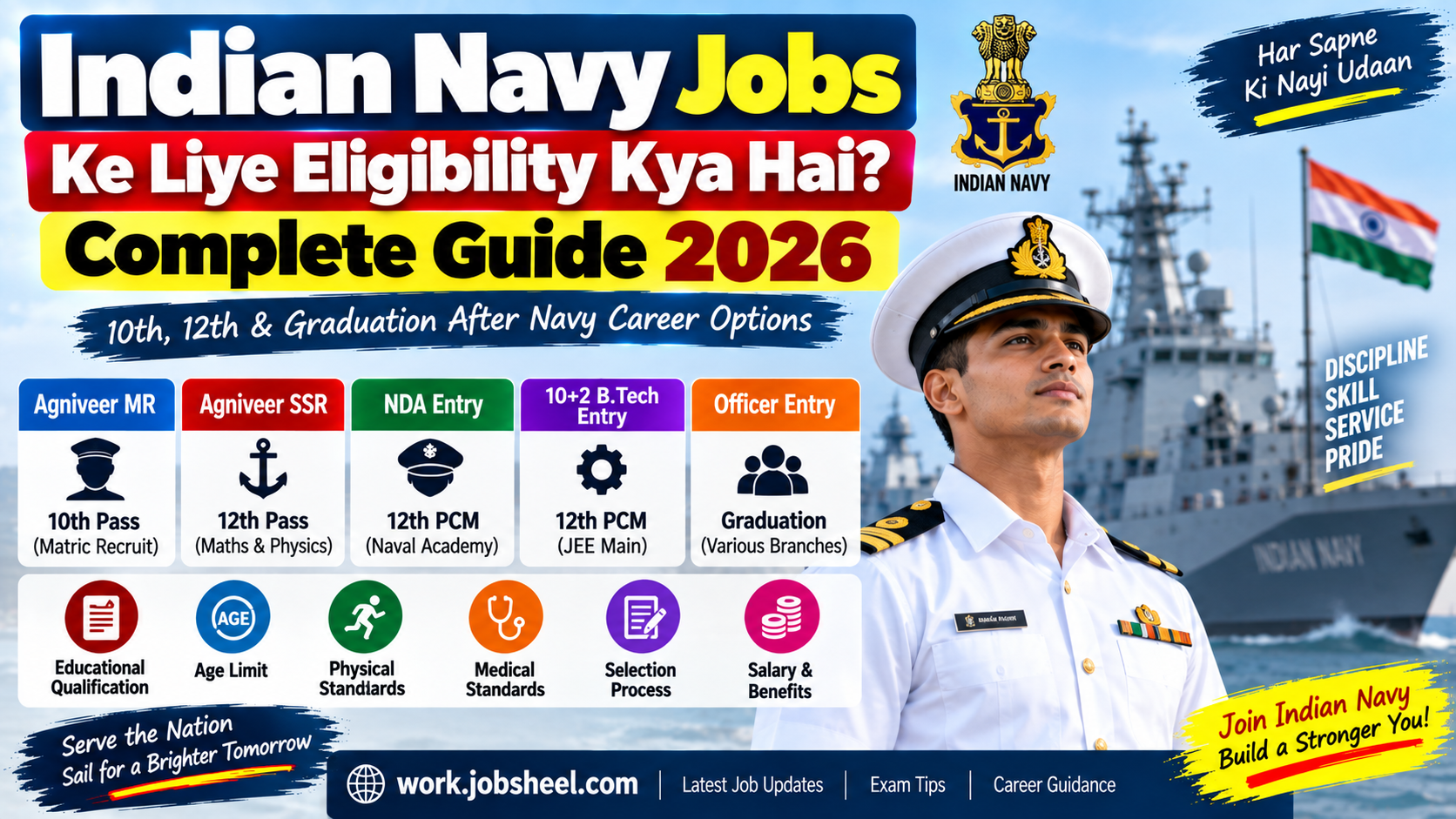

How to Join Indian Navy After 10th and 12th is a common question among students who want a career in Defence, technical operations, discipline and the maritime environment. The Indian Navy offers different entry routes after Class 10, Class 12, graduation and engineering, but the educational qualification is not the same for every post.
Eligible Class 10 candidates can consider Agniveer MR, while students who complete Class 12 with Mathematics and Physics can explore Agniveer SSR. PCM students can also target Commissioned Officer routes such as NDA and Naval Academy or the Indian Navy 10+2 B.Tech Cadet Entry Scheme.
Graduates and engineering students may have additional Officer opportunities through CDSE and branch-specific Short Service Commission or Permanent Commission entries when notified.
Educational qualification alone is not enough. Indian Navy selection can also involve age and date-of-birth requirements, marital-status conditions, written examinations, Physical Fitness Tests, medical standards, SSB interviews and final merit depending on the entry.
This guide explains How to Join Indian Navy After 10th and 12th through 10 important points covering Agniveer MR, SSR, physical fitness, medical standards, NDA, B.Tech Cadet Entry, graduate Officer routes, INET and the Agniveer service structure.
You can also explore our guides on 10th Pass Government Jobs, 12th Pass Government Jobs and How to Join Indian Army After 10th and 12th.
Table of Contents
How to Join Indian Navy After 10th and 12th – 10 Important Routes and Rules
The correct Indian Navy career path depends on your educational background and whether you want to join as an Agniveer or become a Commissioned Officer.
1. First Decide Which Indian Navy Entry You Want
The first step in understanding How to Join Indian Navy After 10th and 12th is deciding whether you want an Agniveer route or an Officer entry.
These routes are completely different in terms of education, selection process, training and long-term career structure.
Indian Navy Entry After Class 10
Agniveer MR is one of the main Navy entry routes for eligible Class 10 candidates.
The applicable notification determines the exact educational percentage, date-of-birth window, physical standards and selection procedure.
Indian Navy Entry After Class 12
Students who complete Class 12 with Mathematics and Physics can consider Agniveer SSR when they meet the current eligibility conditions.
PCM candidates may also explore NDA and Naval Academy and the Navy’s 10+2 B.Tech Cadet Entry Scheme.
Indian Navy Officer Entry After Graduation
Graduates and engineers can explore branch-specific Officer recruitment such as CDSE and notified Navy SSC or PC entries.
Branches can include Executive, General Service, Pilot, Naval Air Operations, Engineering, Electrical, Logistics, IT and other specialisations depending on the recruitment cycle.
Current recruitment notices and career information should always be checked through the official Join Indian Navy website.
2. Agniveer MR Eligibility After Class 10
Agniveer MR, or Matric Recruit, is an important Navy option for eligible Class 10 candidates.
Indian Navy’s updated eligibility criteria state that an Agniveer MR candidate must pass the Matriculation Examination from a Board of School Education recognised by the Ministry of Education with at least 50% aggregate marks.
Candidates awaiting their Class 10 Board result may also be permitted to apply in certain recruitment cycles subject to the conditions in the notification, but they must produce the required original marksheet at the relevant recruitment stage.
What Type of Work Can Agniveer MR Involve?
MR recruitment has historically been associated with support and logistics-related roles such as Chef, Steward and Hygienist, subject to current service requirements and recruitment policies.
The actual assignment is decided by the Indian Navy according to organisational requirements.
Agniveer MR Age and DOB
Indian Navy Agniveer eligibility is usually published as a specific date-of-birth window for each batch rather than one permanent age figure.
For example, the referenced 02/2026 recruitment information used a batch-specific date-of-birth window. Future MR batches can use different dates, so candidates should always check the active notification.
3. Agniveer SSR Eligibility After Class 12
Agniveer SSR, or Senior Secondary Recruit, is one of the major Navy routes for students who complete Class 12 with the required Science subjects.
The Indian Navy’s updated eligibility criteria require candidates to pass 10+2 with Mathematics and Physics with at least 50% aggregate marks from a recognised Board.
Alternative Qualification Routes for SSR
The eligibility framework also provides alternative routes through certain recognised three-year engineering diploma programmes.
An eligible two-year vocational course containing the prescribed non-vocational Physics and Mathematics subjects can also be accepted when specified by the current rules.
Candidates should carefully compare the exact name of their diploma or vocational qualification with the active Navy notification.
What to Study for Agniveer SSR
Recent Navy entrance examination formats for SSR have included subjects such as English, Science, Mathematics and General Awareness.
The standard of the paper is generally linked to the prescribed Senior Secondary level.
Students planning to target SSR should therefore take Mathematics and Physics seriously during Class 11 and Class 12 instead of beginning preparation only after Board examinations.
4. Indian Navy Physical Fitness Test Requirements
Physical fitness is a major part of How to Join Indian Navy After 10th and 12th.
Qualifying the Physical Fitness Test is mandatory for applicable Agniveer recruitment.
Recent PFT Standard for Male Candidates
- 1.6 km Run: 6 minutes 30 seconds
- Squats: 20
- Push-ups: 15
- Bent-Knee Sit-ups: 15
Recent PFT Standard for Female Candidates
- 1.6 km Run: 8 minutes
- Squats: 15
- Push-ups: 10
- Bent-Knee Sit-ups: 10
These standards should not be treated as permanent for every future batch. The latest Navy notification is always the final authority.
How to Prepare for Navy Running
Do not begin by attempting your fastest possible 1.6 km run every day.
First improve aerobic endurance through easy running and jogging. Then gradually add interval training and timed 1.6 km attempts.
Push-ups, squats and core exercises should be trained through controlled sets with proper technique.
Rest, hydration and adequate nutrition are also part of physical preparation.
5. Indian Navy Height and Medical Standards
Passing the written test and PFT does not automatically mean that a candidate is medically fit for Naval service.
Recruitment medical examinations are carried out according to current military medical standards.
Minimum Height for Agniveer
Recent Agniveer eligibility material lists a minimum height standard of 157 cm for male and female Agniveer candidates, while specific domicile-based height relaxations can apply according to the applicable rules.
Because Navy medical and height standards can be updated or differ across specific entries, candidates should check the active recruitment notification and medical guidelines before applying.
Navy Eyesight Requirements
Current Navy eligibility material contains specific uncorrected and corrected vision standards and colour-perception requirements for Agniveer recruitment.
Candidates who use spectacles, have undergone refractive surgery or have an eye condition should read the current medical regulations carefully instead of relying on informal advice.
Tattoo Rules
Permanent body tattoos are subject to Navy restrictions. Recent recruitment material permits tattoos only in specified areas such as approved portions of the inner forearm or hand, subject to the detailed regulations.
Never pay a person claiming they can bypass an official Navy medical examination.
6. How to Become an Indian Navy Officer After Class 12 – NDA
Candidates who want to become Commissioned Officers should understand that the NDA route is completely different from Agniveer MR or SSR.
The National Defence Academy and Naval Academy Examination is conducted by the Union Public Service Commission.
For Navy and Naval Academy educational eligibility, candidates need the prescribed Class 12 qualification with Physics, Chemistry and Mathematics according to the applicable UPSC rules.
The exact age and date-of-birth requirements are provided in each UPSC NDA notification.
UPSC released the NDA & NA Examination (II), 2026 notification on May 20, 2026, with the examination scheduled for September 13, 2026.
Candidates can check official examination information through the UPSC website.
NDA Selection Process
NDA is not simply a written examination followed by direct appointment.
Eligible candidates must first qualify through the UPSC written examination and then face the Services Selection Board process.
SSB evaluates qualities such as officer potential, intelligence, communication, psychological suitability, teamwork and leadership.
Medical fitness and final merit are also important parts of final selection.
7. Indian Navy 10+2 B.Tech Cadet Entry
The Indian Navy 10+2 B.Tech Cadet Entry Scheme is an important Officer route for eligible PCM students.
Official Navy Officer eligibility material lists the broad academic requirement as:
- At least 70% aggregate in Physics, Chemistry and Mathematics in Class 12
- At least 50% in English in Class 10 or Class 12
Candidate shortlisting for SSB is based on the applicable JEE Main ranking framework.
Why JEE Main Matters for Navy B.Tech Entry
Candidates should not assume that meeting the PCM percentage automatically guarantees an SSB call.
JEE Main rank is an important shortlisting factor under the official entry framework.
A practical roadmap is:
Study PCM Seriously → Appear in JEE Main → Monitor Navy B.Tech Notification → Apply Online → Get Shortlisted → Clear SSB → Clear Medical → Final Merit.
Because JEE Main year and course dates change, candidates must use the notification for the specific B.Tech Cadet Entry course they are applying for.
8. Indian Navy Officer Entry After Graduation or Engineering
There are also multiple possibilities for candidates who want to join the Indian Navy after graduation or engineering.
Combined Defence Services Examination
CDSE is conducted by UPSC and can provide a route to eligible Defence academies and services according to the applicable examination notification.
UPSC’s Combined Defence Services Examination (II), 2026 was also scheduled for September 13, 2026.
Navy Short Service Commission Entries
The Navy can also notify Short Service Commission opportunities in various branches.
- Executive / General Service
- Pilot
- Naval Air Operations Officer
- Engineering
- Electrical
- Naval Constructor
- Logistics
- Information Technology
- Education and other notified branches
Many technical branches require BE or B.Tech in specifically approved engineering disciplines.
Some entries can accept other graduate or postgraduate qualifications according to the post.
A BA, B.Com, B.Sc. or engineering degree does not automatically provide eligibility for every Navy Officer branch.
Candidates should identify their preferred Navy branch early so that they can choose a suitable degree and maintain the required academic performance.
Graduates can also explore our guide on Government Jobs After Graduation.
9. Indian Navy Agniveer Selection Process
Understanding the selection process is an important part of learning How to Join Indian Navy After 10th and 12th.
Recent Agniveer SSR and MR recruitment has used the Indian Navy Entrance Test, commonly known as INET, as an important selection stage.
INET for Agniveer SSR
Recent SSR recruitment material has used a computer-based objective examination covering subjects such as English, Science, Mathematics and General Awareness.
Candidates are required to satisfy the applicable sectional and overall qualifying standards prescribed by the Navy.
INET for Agniveer MR
MR recruitment uses an examination pattern suited to the Matriculation-level entry, with subjects and question structure specified in the relevant notification.
Stage-II Recruitment
Candidates shortlisted from the applicable entrance stage can proceed to further recruitment stages such as the Physical Fitness Test, additional examination or assessment where prescribed and medical examination.
Final shortlisting can depend on batch requirements, vacancies, merit, medical fitness and other applicable rules.
Minimum eligibility only gives a candidate the opportunity to compete. It does not guarantee selection.
10. Indian Navy Agniveer Salary, Service and Permanent Selection
Agniveer Navy recruitment should not be confused with automatic permanent sailor service.
Agniveers are enrolled for a four-year service period under the Agnipath framework.
Agniveer Navy Monthly Package
- First Year: ₹30,000 monthly customised package
- Second Year: ₹33,000
- Third Year: ₹36,500
- Fourth Year: ₹40,000
Under the scheme structure, 70% forms the in-hand component and 30% is contributed by the Agniveer to the Corpus Fund, with a matching Government contribution.
Across four years, the candidate contribution and Government contribution are shown as ₹5.02 lakh each before applicable interest.
Life Insurance
Recent Navy Agniveer recruitment material lists a ₹48 lakh non-contributory life-insurance cover during the engagement period.
Does Every Navy Agniveer Become Permanent?
No. Permanent regular-cadre enrolment is not automatic.
Under the Agnipath framework, up to 25% of a specific batch can be considered for further regular enrolment according to organisational requirements, performance and applicable policy.
Candidates should understand the four-year service model, retention policy and long-term career implications before applying.
How to Choose Indian Navy Entry According to Qualification
If you are confused about How to Join Indian Navy After 10th and 12th, first match your education with the available entry route.
After Class 10
Eligible candidates can consider Agniveer MR when they satisfy the current minimum academic marks, age and other recruitment conditions.
After Class 12 With Mathematics and Physics
Eligible students can consider Agniveer SSR and other routes for which their complete subject combination is accepted.
After Class 12 PCM
PCM students can consider Agniveer SSR as well as Commissioned Officer routes such as NDA/Naval Academy and the Navy 10+2 B.Tech Cadet Entry where all eligibility conditions are met.
After Class 12 PCB
Notification-specific medical or specialised Navy recruitment can sometimes be available for eligible PCB candidates. Candidates should use the current recruitment notice to verify whether such an entry is open and what marks or subject conditions apply.
After Graduation or Engineering
Graduates and engineers can monitor CDSE and branch-specific Officer recruitment. Eligibility can depend on degree, engineering discipline, marks, age and branch.
How to Prepare for Indian Navy Recruitment
A good Navy preparation plan should combine written examination preparation, physical fitness and early medical-awareness.
1. Verify Eligibility First
Check education, marks, date of birth, marital status and medical requirements before spending months preparing for a particular entry.
2. Follow the Official Syllabus
Use the syllabus and sample papers provided for the applicable Navy recruitment instead of preparing from random online lists.
3. Strengthen Mathematics and Science
Mathematics and Science are particularly important for SSR and technical or Officer routes involving PCM.
4. Improve English and General Awareness
Recent Navy entrance patterns also include English and General Awareness in applicable exams.
5. Start PFT Training Early
Practise running, squats, push-ups and core exercises regularly instead of trying to achieve the standard only a few weeks before the recruitment stage.
6. Check Medical Standards Early
If you have concerns related to eyesight, previous surgery, hearing or another medical issue, read the current official standards early in your preparation.
7. Prepare for SSB if Targeting Officer Entry
NDA, 10+2 B.Tech and other applicable Officer routes can involve SSB. Work on communication, confidence, current affairs, teamwork, reasoning and officer-like qualities alongside academic preparation.
How to Apply for Indian Navy Jobs
Candidates should submit applications only through official recruitment channels when the relevant application window opens.
Step 1: Visit Join Indian Navy
Open the official Join Indian Navy portal.
Step 2: Choose Agniveer or Officer Entry
Open the notification that matches your educational qua


[…] in other Defence careers can also read our guides on How to Join Indian Army After 10th and 12th, How to Join Indian Navy After 10th and 12th and 12th Pass Government […]