
How to Prepare for Government Jobs is one of the first questions beginners ask when they decide to start preparing for a Sarkari Naukri. With SSC, Railways, Banking, Police, Defence, UPSC and State Government examinations available, many candidates become confused about which exam to choose, what to study first, which books to use and whether coaching is necessary.
The first step toward successful Government-job preparation is not studying for 10 or 12 hours every day. It is choosing the correct examination, understanding its official syllabus and building a realistic study plan.
The Staff Selection Commission publishes a tentative examination calendar covering major recruitments such as CGL, CHSL, Selection Posts, Stenographer, MTS, CPO and GD. UPSC also publishes annual examination calendars, allowing candidates to plan preparation before notifications and examination dates arrive.
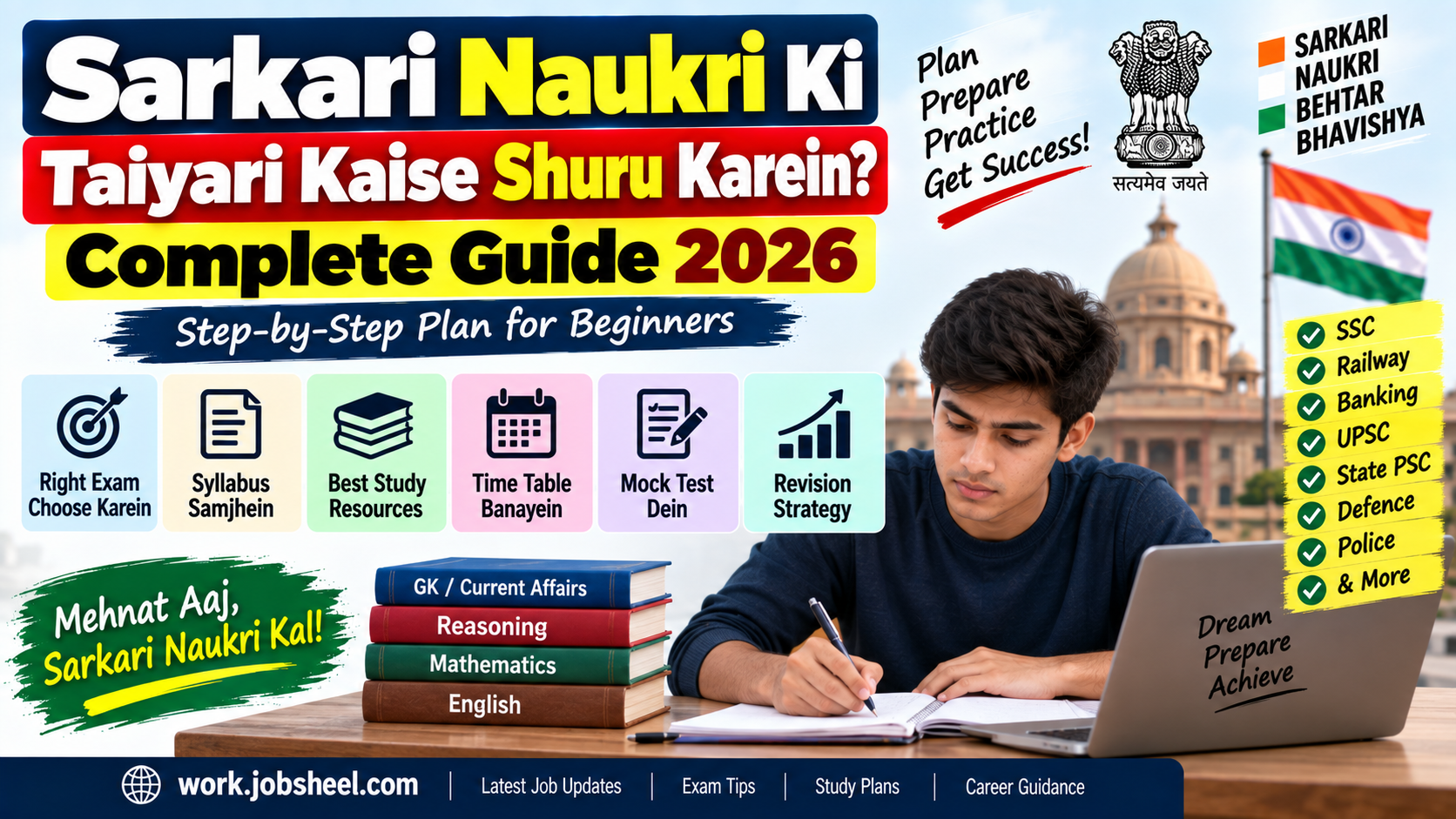
This complete guide explains How to Prepare for Government Jobs through 10 practical steps, along with a beginner-friendly 90-day study plan, useful resources and important mistakes to avoid.
If you are still deciding which career to target, explore our guides on 10th Pass Government Jobs, 12th Pass Government Jobs, Government Jobs After Graduation and Government Jobs Without Exam.
Table of Contents
How to Prepare for Government Jobs – 10 Smart Steps for Beginners
Government examination preparation becomes much easier when candidates follow a structured process instead of randomly studying every available subject.
1. Choose the Right Government Exam According to Your Qualification
The first step in learning How to Prepare for Government Jobs is choosing the correct examination according to your education, age and career preference.
One of the most common beginner mistakes is trying to prepare for SSC, UPSC, Railways, Banking, Police and Defence examinations at the same time.
Every examination has a different syllabus, competition level, eligibility structure and selection process. Preparing for too many unrelated examinations can reduce focus.
Government Exams After Class 10
Class 10 candidates can explore eligible SSC MTS recruitment, Railway Level-1 posts, India Post GDS and notification-specific Defence or Police opportunities.
Read our detailed 10th Pass Government Jobs guide before choosing a target.
Government Exams After Class 12
Eligible Class 12 candidates can consider SSC CHSL, Stenographer, Railway NTPC Undergraduate, Defence entries and different State-level clerical or Police recruitments.
More options are explained in our 12th Pass Government Jobs guide.
Government Exams After Graduation
Graduates can explore SSC CGL, Railway NTPC Graduate, Banking PO, SSC CPO, UPSC Civil Services, State PSC and many other recruitment routes.
See our Government Jobs After Graduation guide for more options.
Choose One Primary Exam and One or Two Backup Exams
A practical strategy is to choose one primary target and one or two backup examinations with overlapping subjects.
For example, an SSC CGL aspirant may also find overlap with certain Railway NTPC and Banking subjects such as Mathematics, Reasoning, English and General Awareness.
Do not select an examination only because of salary. Also check age limits, educational qualification, physical requirements, syllabus, posting conditions and actual job profile.
2. Download the Official Syllabus Before Buying Books
After choosing your target examination, do not immediately start buying books and online courses.
First download the official syllabus and examination pattern.
For SSC examinations, check the latest notification and examination scheme through the official Staff Selection Commission website.
UPSC candidates should use the official examination notice and syllabus published on the Union Public Service Commission website.
Create a Syllabus Tracker
Print the syllabus or save it where you can check it every day.
Divide every topic into three categories:
- Not Started
- In Progress
- Completed
For example, Quantitative Aptitude may include topics such as Percentage, Ratio, Profit and Loss, Average, Time and Work, Algebra and other examination-specific areas.
Your first week should not be about finishing the entire syllabus.
The goal should be understanding the complete syllabus and identifying strong and weak topics.
Do not decide your syllabus from random YouTube videos. Videos can help explain concepts, but the official notification should remain your final syllabus reference.
3. Start With Previous Year Question Papers
Previous-year papers are one of the most valuable resources for candidates learning How to Prepare for Government Jobs.
Many beginners wait until the entire syllabus is complete before opening a previous paper. That is not always the best strategy.
During the first week of preparation, look at one or two previous examination papers.
You do not need to worry about your score at this stage.
Why Previous Papers Matter
Previous papers show you:
- The actual difficulty level of the exam
- Frequently repeated topics
- Question style
- Important chapters
- Time pressure
- How deeply a topic is tested
For example, a book may contain hundreds of complicated Percentage questions. Previous papers help you understand what level of Percentage questions your target exam actually asks.
Maintain an Error Notebook
Whenever you solve previous questions, maintain a separate notebook for mistakes.
Do not write only the correct answer.
Also identify why you made the mistake:
- Concept was unclear
- Calculation mistake
- Question was read incorrectly
- Formula was forgotten
- Time pressure caused an error
This simple habit makes preparation increasingly exam-oriented.
4. Create a Realistic Daily Government Job Study Timetable
Creating a timetable is easy. Following it consistently is the difficult part.
Do not create an unrealistic 12–14 hour study schedule simply because another candidate claims to study that much.
Your timetable should match your actual daily routine.
Study Hours for Full-Time Students
A full-time aspirant may be able to complete five to seven focused study hours effectively depending on concentration, preparation level and examination.
Study Hours With College or Job
Candidates preparing alongside college or employment can still make progress with two to four consistent focused hours.
Simple Daily Study Routine
- Morning: Difficult subject such as Mathematics
- Afternoon: Reasoning or examination-specific subject
- Evening: English or Hindi
- Night: General Awareness and revision
Keep a short revision block every day.
Revising today’s concepts again tomorrow for even 10–15 minutes can improve retention.
Plan Weekly Instead of Overloading Every Day
A weekly target system is often more practical than creating ten daily targets and completing only four.
For example, a weekly plan may include:
- Complete Percentage
- Finish three Reasoning chapters
- Revise vocabulary
- Complete one previous paper
- Take two sectional mock tests
Government exams reward long-term consistency. Studying 12 hours once and doing nothing for the next three days is usually less useful than disciplined daily study.
5. Build Strong Basics Before Learning Shortcuts
Short tricks are popular in Mathematics and Reasoning preparation, but beginners should not build their entire strategy around shortcuts.
A shortcut works best after the underlying concept is clear.
If a candidate does not understand Percentage properly and only memorises one trick, a slightly different question can create confusion.
Mathematics Basics
Revise fractions, percentages, ratios, averages, arithmetic operations, basic algebra and calculation techniques.
English Basics
Work on grammar, vocabulary, reading comprehension and sentence understanding.
Reasoning Basics
Understand the pattern behind each type of reasoning question rather than memorising answers.
General Awareness Basics
Study static topics such as History, Geography, Polity, Economy and General Science in a structured manner.
A useful preparation sequence is:
Accuracy → Speed → Speed + Accuracy.
Trying to solve every question against a stopwatch from the first day can create unnecessary pressure.
Investing the first several weeks in foundations can make later mock-test preparation much easier.
6. Prepare Current Affairs and General Awareness Daily
Current Affairs should not be left until the final 15 days before an examination.
A daily 20–30 minute routine can be more manageable than attempting to cover months of news at the last moment.
What to Cover in Current Affairs
- National developments
- Economy
- Science and technology
- Important appointments
- Government schemes
- Sports
- Important reports and awards
- Examination-specific topics
Do not try to memorise every newspaper line.
Use previous papers to understand how deeply your target examination tests Current Affairs.
Current Affairs and General Awareness Are Different
Current Affairs covers recent developments, while General Awareness also includes static subjects such as History, Geography, Polity, Economy and Science.
The level required for UPSC can be very different from the level needed for many objective SSC-type examinations.
This is another reason why How to Prepare for Government Jobs cannot have one identical study plan for every examination.
Maintain monthly revision notes rather than collecting endless daily PDFs.
Revision is more important than simply consuming large quantities of Current Affairs content.
7. Start Mock Tests Before Completing the Entire Syllabus
Many beginners say, “I will finish the complete syllabus first and then start mock tests.”
The problem is that a competitive-exam syllabus rarely feels completely finished.
After approximately three or four weeks of preparation, candidates can begin sectional testing according to their progress.
For example, if you complete Percentage and Profit & Loss, attempt a sectional test covering those topics.
Mock Test Analysis Is More Important Than the Score
After every mock, divide questions into four categories:
- Correct and easy
- Correct but time-consuming
- Wrong because the concept was weak
- Wrong because of a silly mistake
Simply completing a 60-minute test and spending only five minutes on analysis limits the value of the mock.
Add weak topics identified through mocks to your next week’s study schedule.
Practise Computer Based Tests Online
Many SSC examinations are conducted in Computer Based Examination format.
Online mock tests help candidates become comfortable with screen-based reading, navigation, question switching and timer pressure.
8. Stop Changing Books, Teachers and PDFs Repeatedly
Resource-hopping is one of the biggest preparation problems among beginners.
One teacher explains a chapter through one method, another gives a shortcut and a third uses a completely different approach.
The candidate then spends more time comparing resources than actually practising questions.
Use Limited Resources Per Subject
A simple resource system can be:
- One concept source
- One practice source
- Previous-year questions
- Mock tests
- Short revision notes
If your current teacher or book explains the syllabus clearly, there is no need to buy a new course every week.
Is Coaching Necessary for Government Jobs?
Paid coaching is not compulsory for every candidate.
Self-study can work when you have a clear syllabus, reliable resources, regular practice and discipline.
Coaching can be helpful for candidates who need structure, doubt support, accountability or expert guidance.
The number of books and courses you own does not determine selection. Effective repeated use of a few good resources is more important.
9. Regularly Check Official Notifications and Exam Calendars
Government-job aspirants must track recruitment updates along with studying.
The Staff Selection Commission’s tentative 2026–27 examination calendar includes major examinations such as CGL, CHSL, Stenographer, MTS, CPO and GD across separate application and examination periods.
The official calendar listed CHSL 2026 Tier-I for July–September 2026, MTS for September–November 2026 and CPO Paper-I for October–November 2026.
Candidates should remember that examination calendars can be revised, so the latest notice on the official website remains the final source.
UPSC also publishes annual calendars and active examination information through its official website.
Use National Career Service for Government Vacancy Links
The National Career Service Government Jobs page provides links to recruitment portals of multiple Government Ministries and Departments.
NCS also states that its registration, job application, interview-processing and other employment-related services are free of cost.
Create a Recruitment Tracker
Create a simple notebook or spreadsheet with these columns:
- Exam Name
- Notification Date
- Application Last Date
- Exam Date
- Application Status
- Admit Card
- Result
Also keep your photograph, signature, Class 10 and 12 marksheets, graduation documents, category certificate and identity documents organised.
Missing an application deadline after months of preparation is an avoidable mistake.
10. Avoid Fake Jobs, Fake Coaching Claims and Motivation Traps
Government recruitment attracts scammers because candidates are highly motivated to secure a job.
Be cautious of claims such as:
- “Pay ₹20,000 and get a Government job.”
- “We can clear your examination for you.”
- “Question paper available before the exam.”
- “Direct Government appointment letter.”
- “Guaranteed selection through an agent.”
National Career Service specifically warns jobseekers against fraudulent communication using the NCS or Ministry of Labour & Employment name.
NCS states that its services are free and advises jobseekers not to pay unnecessary fees to employers or people pretending to represent the service.
Use official recruitment websites before paying any legitimate examination or application fee.
Avoid Unrealistic Study Claims
Study-related claims such as “SSC selection in 30 days,” “complete Mathematics in seven days” or “study only these 500 questions” can sound attractive but should not replace systematic preparation.
Consistency may feel less exciting than motivational videos, but it is more useful for long-term examination preparation.
Compare your current mock score with your previous score rather than comparing your progress with every other aspirant online.
If your score improves from 45 to 60 after a month of focused preparation, that is measurable progress.
90-Day Plan: How to Prepare for Government Jobs as a Beginner
A 90-day plan can help beginners create an exam-oriented foundation. It should be adjusted according to the actual examination and your current preparation level.
Days 1–30: Build the Foundation
- Choose the target examination.
- Download the official syllabus.
- Analyse previous-year papers.
- Start basic Mathematics and Reasoning concepts.
- Begin English or Hindi preparation.
- Start daily Current Affairs.
- Create short revision notes.
The objective of the first month is not perfection. It is building clarity and consistency.
Days 31–60: Increase Practice
- Increase daily practice questions.
- Start sectional mock tests.
- Continue static General Awareness.
- Revise the first month’s topics.
- Maintain the error notebook.
- Work on calculation and solving speed.
Days 61–90: Move Toward Exam Mode
- Solve more previous-year papers.
- Attempt full-length mock tests.
- Analyse every mock carefully.
- Revise weak topics.
- Revise formulas and short notes.
- Practise time management.
This is not a universal guarantee or fixed preparation duration.
Examinations such as UPSC Civil Services usually require a much longer and deeper preparation cycle, while some objective SSC, Railway or Banking examinations may require different timelines depending on the candidate’s existing knowledge.
The main purpose of the first 90 days is to establish a disciplined study habit and examination-oriented foundation.
Basic Resources for Government Job Preparation
Candidates do not need hundreds of PDFs and courses to begin preparing.
A practical starter resource list includes:
- Latest official syllabus
- Latest recruitment notification
- Previous-year question papers
- One reliable concept source for each subject
- One practice-question source
- Online mock-test platform or test series
- Short revision notebook
- Official examination calendar
- Reliable Current Affairs revision source
Once these resources are available, collecting dozens of additional books and PDFs is usually unnecessary.
Common Government Job Preparation Mistakes
Beginners can save months of preparation by avoiding a few common mistakes.
- Preparing for too many unrelated exams at once
- Ignoring the official syllabus
- Not looking at previous-year papers early
- Creating an unrealistic timetable
- Learning shortcuts without understanding basics
- Ignoring revision
- Waiting too long before attempting mocks
- Changing teachers and books repeatedly
- Depending entirely on motivational videos
- Missing official application deadlines
Frequently Asked Questions About How to Prepare for Government Jobs
How Should a Beginner Start Government Job Preparation?
First choose one target examination according to your qualification and career goal. Download its official syllabus, analyse previous-year papers and then create a realistic subject-wise study plan.
How Many Hours Should I Study for Government Exams?
There is no universal number. Focused and consistent study is more important than claiming a very high number of study hours. Your schedule should depend on your available time and examination level.
Should I Join Coaching for Government Jobs?
Coaching is not compulsory for every candidate. Self-study can work with the right syllabus, resources, practice and discipline. Coaching may help candidates who need structure or doubt support.
When Should I Start Mock Tests?
You do not need to wait until the entire syllabus is complete. Sectional tests can begin after you complete a few topics, followed gradually by full-length mocks.
Are Previous Year Papers Important?
Yes. Previous papers help you understand the actual examination level, repeated topics, question style and time pressure.
How Should I Prepare Current Affairs?
Study a small amount regularly and revise monthly. The required depth should match your target examination instead of trying to memorise every news story.
Is a 90-Day Plan Enough for Government Job Preparation?
Ninety days can be useful for building a strong beginner foundation, but the total preparation time depends on the examination, competition and candidate’s existing knowledge.
Where Can I Check Government Exam Dates?
Use the official websites of SSC, UPSC, RRBs, IBPS, State PSCs and other concerned recruiting authorities. National Career Service also provides links to Government recruitment portals.
How Can I Avoid Fake Government Job Offers?
Verify every vacancy through the official recruitment website. Never pay a private agent who promises guaranteed Government selection, question papers, direct appointment or manipulation of results.
Conclusion – How to Prepare for Government Jobs Successfully
Understanding How to Prepare for Government Jobs becomes much easier once you stop studying randomly and begin following an exam-specific strategy.
Start by choosing the correct examination according to your qualification and career goal. Download the official syllabus and analyse previous-year question papers before collecting books and courses.
Build strong basics, use a realistic timetable and start revision and mock tests early.
Current Affairs should be prepared regularly, while official examination calendars and recruitment notifications should be monitored so that you do not miss important application dates.
The simplest Government-job preparation roadmap is:
Choose Target Exam → Download Official Syllabus → Build Basic Concepts → Analyse Previous Papers → Practise Questions → Start Mock Tests → Analyse Mistakes → Revise → Attempt the Exam.
There is no guaranteed shortcut to selection. Consistency, correct direction, repeated revision and exam-oriented practice are more useful than constantly changing resources.
For more career guides, visit Work JobSheel, explore our SSC Jobs guide and read Government Jobs After Graduation.
Disclaimer
Disclaimer: This article is intended only for educational and general career-guidance purposes. Government examination qualifications, age limits, vacancies, syllabi, examination patterns, notification dates and selection processes can change according to the recruiting authority and examination cycle.
Examination schedules mentioned in this article are based on current official calendars and examples. SSC, UPSC and other examination calendars can be tentative or revised.
Before applying for any Government vacancy, candidates should carefully verify the latest notification issued by SSC, UPSC, Railway Recruitment Boards, IBPS, State PSCs, National Career Service or the concerned official recruiting authority.
work.jobsheel.com is not affiliated with any Government department, recruitment commission or examination authority and does not guarantee selection or Government employment.
Never pay an agent, middleman or unknown person claiming that they can provide a Government job, leaked examination paper, guaranteed selection or direct appointment.