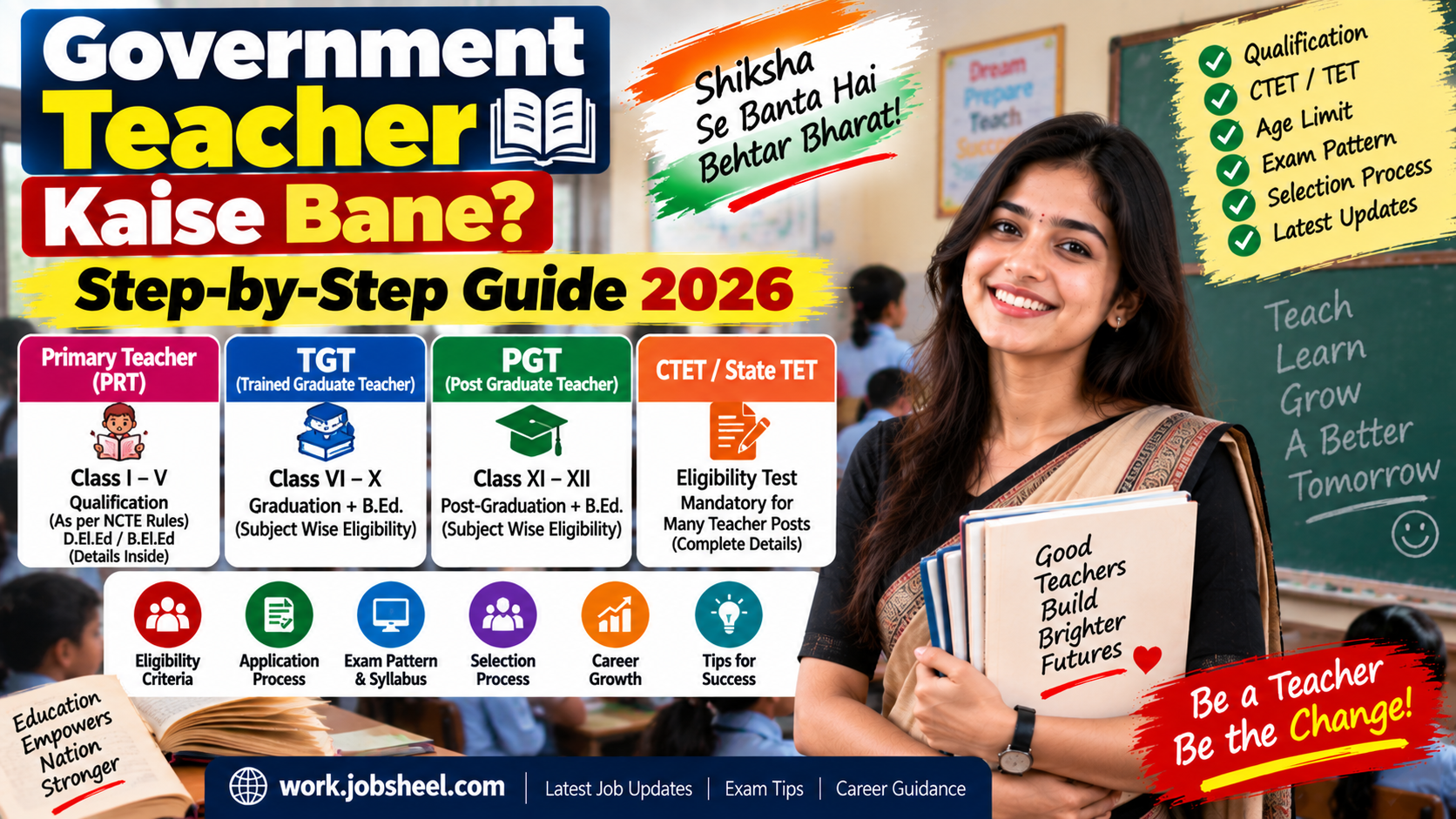

How to Become a Government Teacher is an important question for students who want a stable and meaningful career in India’s education sector. Government teaching offers multiple career routes, including Primary Teacher, Trained Graduate Teacher (TGT), Post Graduate Teacher (PGT) and different State Government teaching posts.
However, becoming a Government Teacher is not as simple as completing graduation or a B.Ed. degree. The required academic qualification, professional teacher-training course and eligibility test depend on the classes you want to teach and the recruiting organisation.
For teachers of Classes I to VIII, the National Council for Teacher Education plays an important role in prescribing minimum qualification frameworks. Teacher Eligibility Tests such as CTET or an appropriate State TET can also be important for relevant appointments.
CTET is conducted by the Central Board of Secondary Education. However, qualifying CTET does not automatically provide a Government Teacher appointment. The final eligibility and recruitment conditions are verified by the concerned appointing authority.
This complete guide explains How to Become a Government Teacher through 10 practical steps covering Primary Teacher, TGT, PGT, D.El.Ed., B.El.Ed., B.Ed., CTET, State TET, recruitment examinations and document verification.
Students exploring other Government careers can also read our guides on 12th Pass Government Jobs, Government Jobs After Graduation and SSC Jobs.
Table of Contents
How to Become a Government Teacher in 2026 – 10 Important Steps
The correct path depends on the teaching level you want to target. The following 10 points explain the complete Government Teacher career roadmap.
1. First Decide Which Level of Teacher You Want to Become
The first step in understanding How to Become a Government Teacher is choosing the teaching level you want to target.
Primary Teacher, TGT and PGT posts do not have identical academic and professional qualifications.
Primary Teacher
Primary teaching is generally associated with Classes I to V. Candidates targeting this level should carefully understand the current elementary teacher-education requirements.
Upper Primary Teacher
Upper Primary generally covers Classes VI to VIII. The NCTE qualification framework provides different academic and professional routes for this level.
TGT – Trained Graduate Teacher
TGT positions are generally associated with subject teaching at middle or secondary-school levels. Graduation subject combinations and professional teaching qualifications can be important.
PGT – Post Graduate Teacher
PGT positions generally involve specialised subject teaching at senior-secondary level and commonly require a relevant postgraduate academic background along with the prescribed professional teaching qualification.
The current minimum teacher-qualification notifications and amendments should be checked through the official National Council for Teacher Education website.
Therefore, your first career question should not simply be “I want to become a teacher.” Instead, decide whether you want to target Primary, Upper Primary, TGT or PGT recruitment.
2. Understand Primary Teacher Qualification
Primary Teacher eligibility must be checked very carefully because old internet advice can create confusion.
Candidates should not automatically assume that completing graduation plus B.Ed. makes them eligible for every Primary Teacher vacancy.
The NCTE elementary-teacher qualification framework has included routes such as Senior Secondary with the prescribed Diploma in Elementary Education, Bachelor of Elementary Education and other recognised elementary teacher-training qualifications.
Graduation along with the prescribed Diploma in Elementary Education has also formed part of notified qualification routes.
D.El.Ed. for Primary Teacher
D.El.Ed. stands for Diploma in Elementary Education. It is specifically connected with elementary teacher education and can be an important professional route for candidates targeting Primary Teacher recruitment where the applicable rules recognise it.
B.El.Ed. for Primary Teacher
B.El.Ed. stands for Bachelor of Elementary Education. It is another recognised teacher-education route included in elementary-school teacher qualification frameworks.
Do Not Assume B.Ed. Alone Is Enough for Primary Teacher
Primary Teacher eligibility has seen regulatory and judicial developments over the years. Candidates should therefore avoid depending on old videos, old blog posts or outdated recruitment advertisements.
Before taking admission in D.El.Ed., B.El.Ed., B.Ed. or another teacher-training programme specifically for a Government Teacher target, check whether the course and institution meet the latest applicable rules.
The final eligibility for a particular vacancy should always be checked in the latest recruitment notification issued by KVS, a State Education Department or another recruiting authority.
3. TGT Qualification – Graduation and B.Ed. Requirements
TGT stands for Trained Graduate Teacher. It is one of the most popular Government teaching careers for graduates who want to teach a particular subject.
Understanding subject combination is extremely important for TGT recruitment.
A candidate targeting TGT Mathematics, for example, should not assume that any bachelor’s degree automatically makes them eligible. The recruiting authority may specify which subjects must have been studied during graduation and for what duration.
Role of Graduation in TGT Eligibility
The bachelor’s degree should match the subject-related eligibility conditions of the vacancy where such conditions are prescribed.
Candidates planning to become English, Mathematics, Science, Hindi or Social Science teachers should consider future TGT subject requirements while choosing their graduation subjects.
Role of B.Ed. in TGT Recruitment
A recognised B.Ed. or another prescribed professional teacher qualification can be an important requirement for TGT recruitment, depending on the recruiting organisation and current rules.
The teacher-training qualification should be completed through an appropriately recognised programme.
CTET Paper-II and TGT Jobs
CTET Paper-II or a State TET requirement may also apply to eligible TGT or upper-primary recruitment according to the rules of the concerned organisation.
Therefore, candidates should plan graduation subjects, professional teacher education and TET preparation together rather than treating them as unrelated steps.
4. PGT Qualification – Post-Graduation Is Important
PGT stands for Post Graduate Teacher. Candidates who want to teach specialised subjects at senior-secondary level can target PGT recruitment.
PGT positions generally require a relevant Master’s Degree along with the prescribed professional teaching qualification, subject to the recruitment rules.
Choose the Correct Post-Graduation Subject
The postgraduate subject can be extremely important.
A candidate targeting PGT Hindi, Mathematics, English, History, Economics, Physics, Chemistry or another subject must satisfy the academic conditions specified for that particular post.
A postgraduate degree in an unrelated subject may not automatically provide eligibility for the subject you want to teach.
Common PGT Career Route
A broad career route can look like:
Relevant Graduation → Relevant Post-Graduation → Prescribed Professional Teaching Qualification → Recruitment Examination.
However, percentage requirements, subject combinations and professional qualifications can differ between organisations.
Candidates should read the recruitment rules of KVS, NVS, State Public Service Commissions, State Education Departments or other recruiting organisations before making a long-term academic decision.
5. Understand the Difference Between CTET and State TET
Understanding CTET and State TET is a crucial part of learning How to Become a Government Teacher.
What Is CTET?
CTET stands for Central Teacher Eligibility Test. It is conducted by the Central Board of Secondary Education.
The CTET framework is connected with Teacher Eligibility Test requirements for relevant appointments covered by applicable RTE and NCTE provisions.
Current notices, Information Bulletins, previous papers and other resources are available through the official CTET website.
What Is State TET?
States can conduct their own Teacher Eligibility Tests for recruitments covered by their respective rules. These are commonly referred to as State TET examinations.
Different States can have different recruitment rules, educational requirements and teacher-selection procedures.
Does CTET Guarantee a Government Teacher Job?
No. Qualifying CTET should not be confused with receiving a Government Teacher appointment.
A candidate must still satisfy the complete educational and professional eligibility requirements of the recruiting organisation and successfully complete the applicable recruitment process.
Think of CTET as an eligibility-related qualification for recruitments where it is applicable, not as an automatic appointment letter.
6. How to Choose CTET Paper-I and Paper-II
CTET candidates should select their paper according to the teaching level they intend to target and the current Information Bulletin.
CTET Paper-I
Paper-I is associated with candidates intending to teach Classes I to V, subject to the current CTET and teacher-qualification rules.
CTET Paper-II
Paper-II is associated with candidates intending to teach Classes VI to VIII, subject to the applicable eligibility conditions.
Applying for or qualifying a CTET paper does not replace the academic and professional qualifications required for appointment.
Candidates remain responsible for confirming that they meet the relevant minimum qualification rules.
CTET September 2026
The September 2026 CTET cycle was announced as the 22nd edition. Candidates should always use the current Information Bulletin instead of relying on eligibility information from older examination cycles.
The official CTET website also provides previous question papers, answer keys and examination-related notices that can be useful during preparation.
7. Where to Check Government Teacher Vacancies
After completing the required academic and professional qualifications, candidates need to monitor genuine Government Teacher recruitment notifications.
Kendriya Vidyalaya Sangathan Recruitment
Candidates targeting Central-school careers can monitor the official Kendriya Vidyalaya Sangathan website.
KVS publishes recruitment notices, results, examination updates and other employment-related information through its official portal.
KVS recruitment activity continued in 2026, with Tier-II results for several PGT, TGT, PRT and other posts under Advertisement No. 01/2025 being published during the year.
State Government Teacher Recruitment
For State Government teaching jobs, candidates should monitor the concerned State Education Department, Staff Selection Board, Public Service Commission or Teacher Recruitment Board.
The exact recruitment authority differs from one State to another.
Avoid Fake Teacher Recruitment Offers
Do not trust advertisements promising “direct permanent Government Teacher joining,” “selection without examination” or guaranteed appointments in exchange for money.
Use private job websites only to discover possible vacancies. Verify the advertisement through the official recruiting organisation before applying.
8. How to Prepare for Government Teacher Recruitment Exams
Qualifying CTET or State TET may not be the final stage for every Government Teacher vacancy.
The recruiting organisation may conduct an additional written examination, subject test, skill assessment, interview or another selection stage.
Primary Teacher Preparation
Depending on the examination, Primary Teacher preparation can include Child Development and Pedagogy, Language, Mathematics, Environmental Studies, General Awareness and other recruitment-specific subjects.
TGT Preparation
TGT candidates should build strong command over the relevant graduation-level teaching subject along with pedagogy and other examination sections.
PGT Preparation
PGT candidates may need stronger subject-depth because specialised teaching posts can test knowledge closer to postgraduate level.
Use Previous Question Papers
Previous examination papers can help candidates understand question style, difficulty and frequently tested areas.
Create a topic-by-topic syllabus checklist and solve regular mock tests.
Maintain a separate notebook for incorrect answers and revise weak areas regularly.
Pedagogy should not be studied only as definitions. Try to understand child development, teaching methods and classroom situations through practical examples.
A strong preparation strategy combines subject knowledge + pedagogy + previous papers + mock tests.
9. Verify Teacher-Training Institute Recognition and Documents
Document Verification can be a critical stage in Government Teacher recruitment.
Even after clearing an examination, candidature can face problems if the required academic or professional certificates do not satisfy the recruitment rules.
Verify Teacher Education Recognition Before Admission
Before spending years on a D.El.Ed., B.El.Ed., B.Ed. or another professional teacher-training programme, verify the recognition status of the institution and programme through appropriate official sources.
NCTE is the statutory body responsible for teacher-education regulatory frameworks and publishes teacher-qualification and recognition-related information.
Important Government Teacher Documents
- Class 10 certificate and marksheet
- Class 12 certificate and marksheet
- Graduation degree and marksheets where applicable
- Post-Graduation degree and marksheets for relevant PGT posts
- D.El.Ed., B.El.Ed., B.Ed. or other prescribed teacher-training certificates
- CTET or State TET certificate where applicable
- Valid identity proof
- Category certificate where applicable
- EWS or PwBD certificate where applicable
- Other documents required by the recruiting authority
Check your name, date of birth, parents’ names and category details across important documents because inconsistencies can create problems during verification.
Do not rely only on a college advertisement while selecting a teacher-training institution. Verify recognition independently before admission.
10. Complete Roadmap: How to Become a Government Teacher
The complete How to Become a Government Teacher roadmap depends on the teaching level you choose.
Primary Teacher Roadmap
A broad Primary Teacher route can be:
Class 12 or applicable academic qualification → recognised elementary teacher-education programme such as the prescribed D.El.Ed./B.El.Ed. route → CTET Paper-I or applicable State TET → Teacher Recruitment Examination → Document Verification.
The actual qualification must match the latest NCTE and recruiting-authority rules.
TGT Roadmap
A broad TGT route can be:
Relevant Graduation → prescribed professional teaching qualification → applicable CTET Paper-II/State TET where required → TGT Recruitment Examination → Document Verification.
Always choose graduation subjects according to the TGT subject you ultimately want to teach.
PGT Roadmap
A broad PGT route can be:
Relevant Graduation → Master’s Degree in the required subject → prescribed professional teaching qualification → PGT Recruitment Examination → Document Verification.
Different recruiting organisations can impose additional percentage, subject-combination or professional-qualification requirements.
This is why old social-media videos should not be treated as permanent eligibility rules.
How Long Does It Take to Become a Government Teacher?
The time required to become a Government Teacher depends on your current educational level and target teaching post.
Primary Teacher Route
A candidate starting after Class 12 needs to complete the applicable recognised elementary teacher-training programme before targeting required TET and recruitment stages.
TGT Route
TGT preparation can take longer because candidates generally need relevant graduation plus the prescribed professional teaching qualification and applicable recruitment eligibility.
PGT Route
PGT is typically a longer academic route because candidates may need graduation, relevant post-graduation and a prescribed professional teaching qualification.
Do not choose an invalid or unsuitable course simply because it appears to offer a faster route. Completing the correct recognised qualification is more important than completing a course quickly.
Benefits of Becoming a Government Teacher
Government Teacher careers remain popular because they can offer long-term career stability, structured pay systems, applicable allowances, leave benefits, promotion opportunities and the satisfaction of working in education.
However, salary is not identical across all Government teaching positions.
PRT, TGT and PGT posts can have different pay levels. Central Government, State Government and other educational organisations can also follow different pay and allowance structures.
Candidates should therefore use the pay level mentioned in the latest recruitment notification instead of relying on a single universal “Government Teacher salary” figure.
Frequently Asked Questions About How to Become a Government Teacher
How Can I Become a Government Teacher After Class 12?
Candidates targeting Primary teaching should check the latest elementary teacher-education qualification routes, complete an eligible recognised programme and then qualify for the applicable CTET or State TET and recruitment process.
Is B.Ed. Enough to Become a Government Teacher?
Not for every Government teaching post. Eligibility depends on the teaching level and recruitment rules. Primary, TGT and PGT posts can require different academic and professional qualifications.
Can I Become a Primary Teacher With Only B.Ed.?
Candidates should not automatically assume that B.Ed. alone provides eligibility for Primary Teacher recruitment. Check the latest applicable NCTE framework and the exact recruiting-authority notification.
What Qualification Is Required for TGT?
TGT recruitment generally requires an appropriate graduation background plus the prescribed professional teacher qualification. Subject combinations and CTET/TET requirements may also apply.
What Qualification Is Required for PGT?
PGT recruitment commonly requires a relevant postgraduate degree along with the prescribed professional teaching qualification. Exact subject and percentage requirements vary by organisation.
Is CTET Compulsory for Every Government Teacher Job?
No single answer applies to every vacancy. CTET may be required for recruitments covered by the relevant rules, while State Government posts may require a State TET or another prescribed eligibility condition.
Does Passing CTET Guarantee a Government Teacher Job?
No. CTET qualification does not automatically create a right to appointment. Candidates must meet the recruiting authority’s complete eligibility conditions and clear its recruitment process.
Where Can I Find Government Teacher Vacancies?
Check official websites of KVS, State Education Departments, State Public Service Commissions, Staff Selection Boards and other authorised teacher-recruitment bodies.
Conclusion – How to Become a Government Teacher Successfully
Understanding How to Become a Government Teacher becomes much easier when you first decide which teaching level you want to target.
Primary Teacher recruitment requires careful attention to recognised elementary teacher-training qualifications. TGT candidates generally need a relevant graduation background and prescribed professional teacher education, while PGT candidates may require a relevant postgraduate qualification along with applicable professional training.
CTET or an appropriate State TET can be an important eligibility component for relevant recruitment, but qualifying a TET does not automatically provide employment.
The safest career strategy is:
Choose Teaching Level → Check Latest Qualification Rules → Complete a Recognised Teacher-Training Programme → Qualify CTET/State TET Where Applicable → Apply for Official Teacher Vacancies → Clear Recruitment Stages → Complete Document Verification.
For more career information, visit Work JobSheel, our 12th Pass Government Jobs guide and Government Jobs After Graduation guide.
Disclaimer
Disclaimer: This article is provided only for educational and general career-awareness purposes. Government Teacher qualifications, percentage requirements, CTET/TET conditions, age limits, reservations, salaries, professional qualifications, subject combinations and recruitment procedures can change according to the State, recruiting organisation, teaching level and recruitment cycle.
Teacher-eligibility rules can also change through NCTE amendments, Government notifications, court decisions and recruiting-authority rules. Therefore, do not automatically assume that D.El.Ed., B.El.Ed., B.Ed. or another teacher-training programme makes you eligible for every Government Teacher vacancy.
Before applying or choosing a teacher-training course for a specific career target, carefully check the latest official information issued by NCTE, CTET, KVS, the concerned State Education Department, Public Service Commission or recruiting authority.
work.jobsheel.com is not affiliated with NCTE, CBSE, CTET, KVS, the Ministry of Education or any Government recruitment authority and does not guarantee Government Teacher selection or employment.
Never pay an agent or unknown person claiming that they can guarantee a Government Teacher appointment or bypass the official recruitment process.